
Why openings go out of square
Valley soils near the Rio Grande can shift with moisture, and older homes often sit on shallow foundations. Over decades, walls settle unevenly. Windows that were square when installed end up as slight parallelograms: wider at the top than the bottom, or taller on one side.
Why it matters
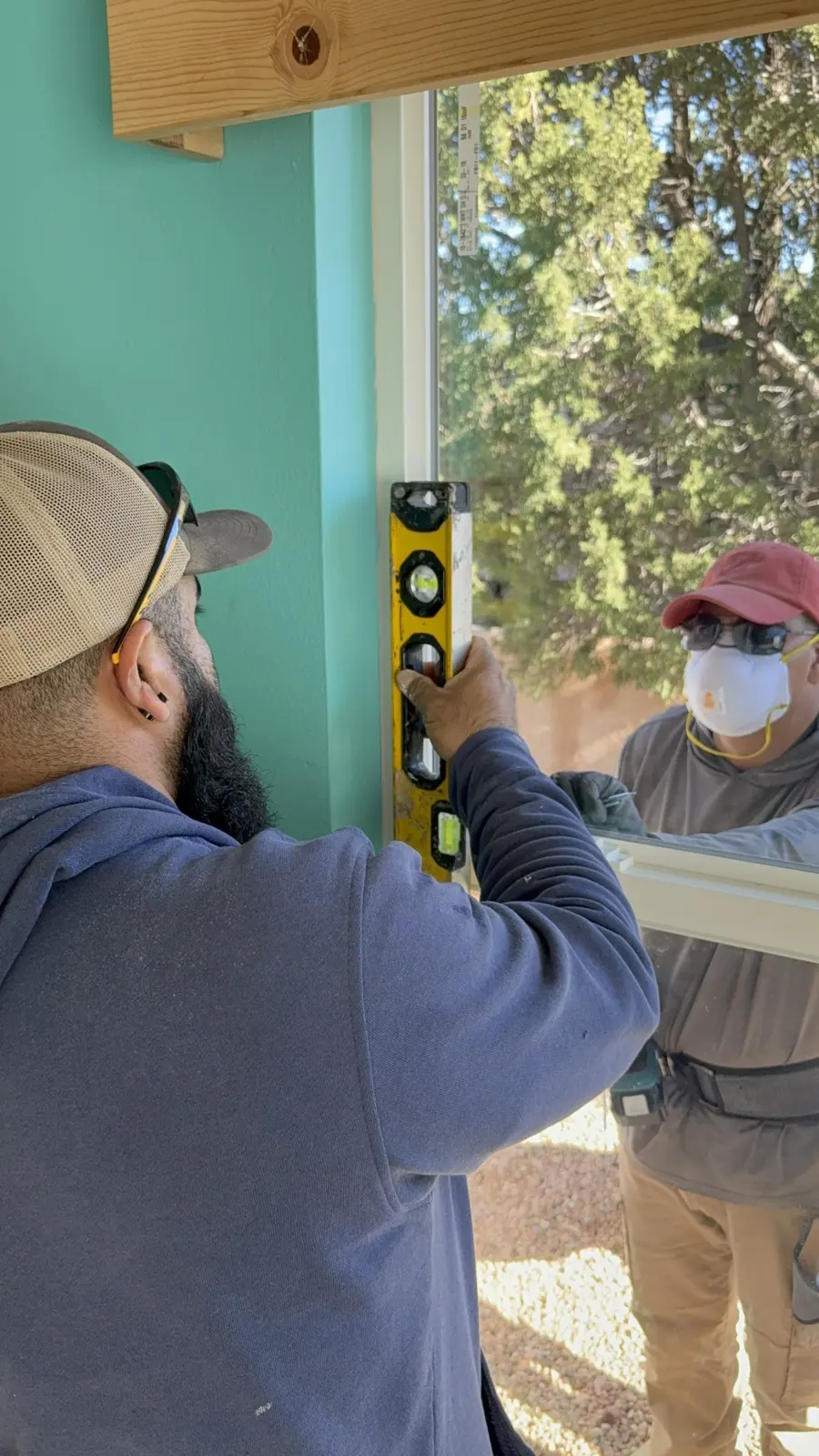
A window has to be level and plumb to work. If a new window follows a crooked opening, sashes bind, locks don't line up, and weatherstrip doesn't seal. It might look fine on install day and give you trouble within a year.
How we measure
We measure the width at the top, middle and bottom, the height at the left, center and right, and both diagonals. If the diagonals differ by more than a small amount, the opening is out of square. We order the window to the smallest dimensions, so it can be set level and plumb with room to shim.
How we install
- Slightly out of square: the window is shimmed level and plumb inside the opening, and the gaps are sealed and trimmed.
- Badly out of square: a full-frame replacement lets us correct the rough opening itself, so the new window sits right and the trim lines look straight.
Trim and appearance
When an opening is out of square but the window is set true, the gap around the window varies. Inside, trim or a reworked drywall return hides it. Outside, sealant or the stucco patch takes up the difference. Done well, you'll see a straight window in a wall that has quietly shifted around it.
Questions about your home? Call (505) 578-2910.
Questions we hear about this
How do I know if my window openings are out of square?
Sashes that bind, locks that won't line up and uneven gaps around the frame are clues. We measure diagonals during the visit to confirm.
Does an out-of-square opening always need full-frame replacement?
No. Slight differences are handled with shimming. Larger ones are better corrected with full-frame work.